

Form popups: collect only what you will use this week
 Emel Dalabasmaz
A form popup is any overlay that asks for fields beyond a single email. Demo requests, support, callbacks and surveys all fit. Keep the first step to three fields or fewer. Omnisend's 2025 set of 1.24 billion displays saw signup conversion fall from about 2.1% to 1.5% at four fields. Consent copy belongs next to the button, not in a cookie banner.
When should a form be a popup instead of a page?
Use a popup when the visitor is already on the right URL and the ask is short. Use a page when the ask is a full application, a long brief or anything with file upload.
Popup-sized:
- newsletter or waitlist (see email popups)
- "book a 15-minute demo" with name, work email, company
- "talk to support" with topic and message
- a callback request, with a phone field that has its own SMS/call consent
- a one-question survey
Page-sized: jobs, credit applications, wholesale account sign-up, anything with 8+ fields.
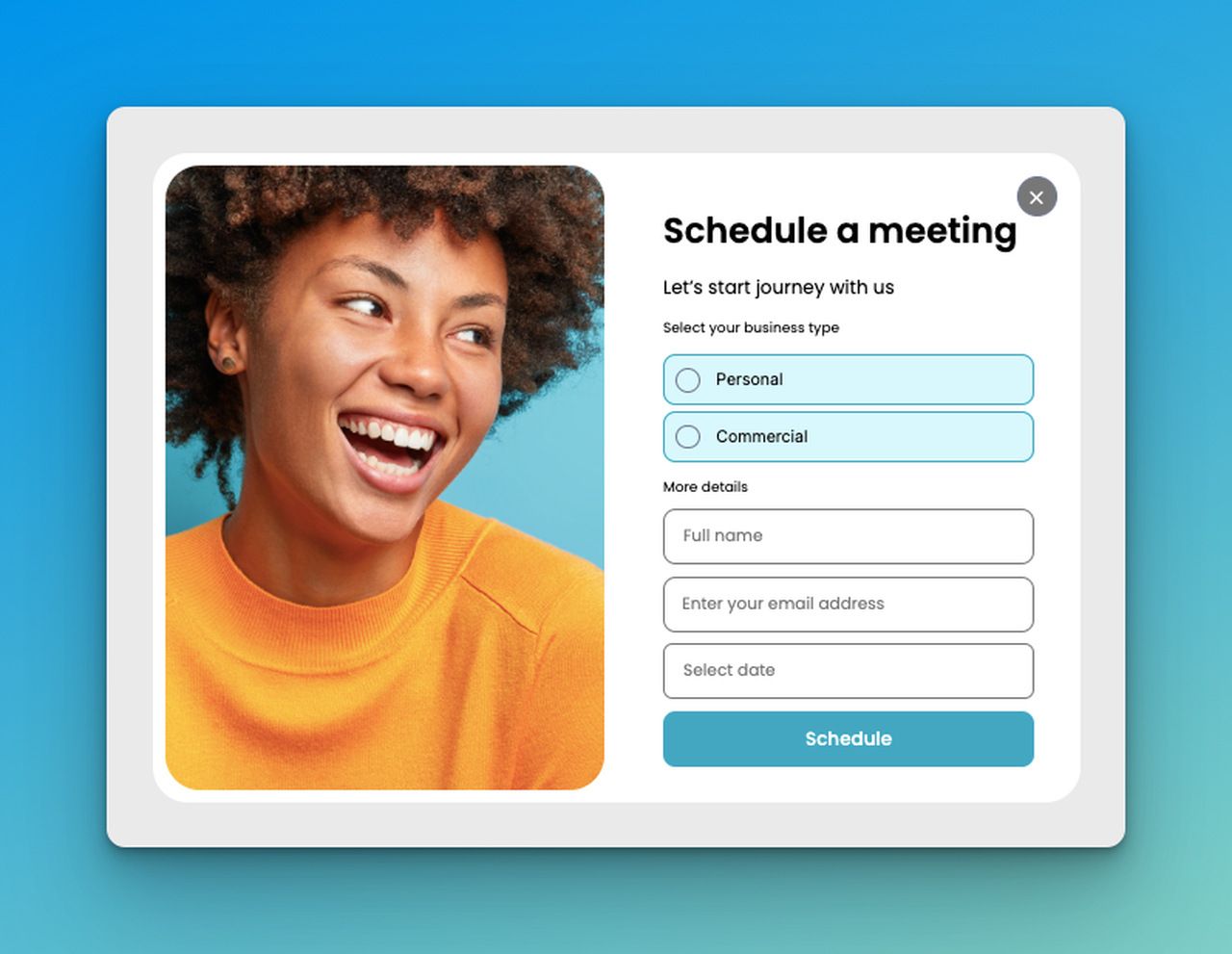
Trigger it from a button on the pricing page, not from a 3-second timer on the homepage. Click-to-open is the form pattern that does not fight Google's intrusive interstitial rule, because the visitor asked for it.
How many fields, and in what order?
Omnisend reported that in 2025, across 1.24 billion displays, conversion held at 2.1% with one field, 2.2% with two, 2.1% with three, then 1.5% at four and 1.4% at five or more. Multi-step forms converted at 2.3% against 2.0% for single-step, a 15% relative gain, not the 200% lifts that still circulate.
| Fields on step one | Signup conversion | What that buys you |
|---|---|---|
| 1 | 2.1% | Email only |
| 2 | 2.2% | Email and a first name |
| 3 | 2.1% | Email, name, one qualifying answer |
| 4 | 1.5% | The cliff. Split the form here |
| 5 or more | 1.4% | A page, not an overlay |
Nothing is lost between one field and three. Everything is lost at four. That is the whole design rule, and it is why "just add company size" is never free.
So: three fields on step one. If you need more, split.
A B2B demo flow that respects that:
- Work email
- "What are you trying to do?" as a short list
- Name and company, after they have a reason to continue
Do not require phone on step one unless the whole product is a phone call. Phone has its own legal bar; see phone number popups.
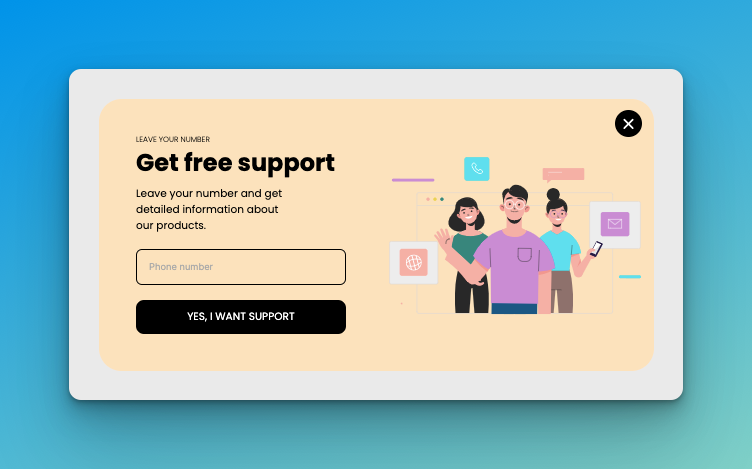
Autofill, autocomplete attributes and a visible close control are not extras. They are how you keep INP and frustration down. Core Web Vitals use INP (200ms or under) as of March 2024. A form script that blocks the first tap is a ranking and a UX problem.
What consent text belongs on the form?
Two separate things get mixed up.
Cookie consent (UK PECR / ICO) is about storing or accessing information on the device. A marketing form is about processing an email or number. Completing one does not complete the other.
For the form itself:
- say who you are and what you will send
- do not pre-tick marketing
- link the privacy notice next to the button
- if you will send marketing email, UK PECR still wants a positive opt-in for electronic mail in most B2C cases
- if you will send marketing SMS in the US, you need prior express written consent under 47 CFR 64.1200, and since 11 April 2025 you must honour revocation by any reasonable means within ten business days (FCC)
GDPR Article 7 still wants consent specific, informed and as easy to withdraw as to give. A single "I agree to everything" tick covering cookies, email, SMS and data sale is the pattern to avoid.
Which builders are actually good at forms?
- OptinMonster is best if you will A/B test field counts and targeting, and you want the report.
- Poptin is best for a small site that wants a free tier with exit-intent and testing before paying.
- Adoric is best if you will segment on behaviour and cookies rather than show the same form to everyone.
- Popupsmart is fine for a support or demo overlay you need live the same day.
On WordPress, Popup Maker (780,000+ active installs) will host the form inside WordPress. OptinMonster (1+ million installs) will host it in their cloud and send it to your ESP. On Shopify, start with the native Forms app or your ESP's forms if the job is "email plus two fields." Add a dedicated popup app when you need click triggers, multi-step, or rules the native app does not have.
Common questions
Does a multi-step form really convert better?
By a little. Omnisend measured 2.3% for multi-step against 2.0% for single-step across 1.24 billion displays — a 15% relative gain, not the tripling that gets quoted in vendor decks. It is worth doing because it lets you ask for four things without a four-field first screen, which is where the real drop happens.
Where should the consent checkbox go?
Next to the submit button, unticked, in text the reader can actually read. Not in the privacy policy, not in a tooltip, and not bundled with three other permissions. GDPR Article 7 wants consent specific and as easy to withdraw as to give, which a single "I agree to everything" tick cannot be.
Should a demo request be a popup or its own page?
A popup if the visitor is already on the pricing page and clicked a button to open it, because then the overlay is a response rather than an interruption. A page if the form has file upload, more than about six fields, or needs to be linkable from a sales email. Click-to-open is also the pattern that does not argue with Google's interstitial guidance.
Can you ask for a phone number in the same form as the email?
You can ask, but not require, and the SMS consent has to be its own statement next to its own control. A number collected under a newsletter opt-in is not consent to text. In the US that is a prior-express-written-consent problem under the TCPA rules, and the field also pushes you toward the four-field cliff for a number you may never call.
Which builder fits form popups
The tools this page argues for, best fit first, with the entry price and billing basis taken from each vendor’s own pricing page.
| Tool | Best for this job | Free tier | Starts at | Metered on |
|---|---|---|---|---|
| OptinMonster | A/B testing field counts and targeting | None | $7Basic, per month, billed annually | Campaign impressions |
| Poptin | Exit-intent and testing before you pay anything | Free plan | $25Basic, per month | Monthly visitors |
| Adoric | Behaviour and cookie segments rather than one form for all | Free plan | $100Basic, per month | Monthly pageviews |
| Popupsmart | A support or demo overlay needed the same day | Free plan | $32.50Basic, per month, billed annually | Monthly pageviews |
Prices researched August 2026. Several tools charge a different rate after the first term; each tool’s own pricing breakdown carries the renewal figure. Where these numbers come from is set out below.
How this page was researched
- Prices come from the vendor, on a date
- The 4 figures in the table above were read from each vendor’s own pricing page in August 2026, not from a feature feed or a comparison chart. Each tool’s pricing breakdown links the page the number came from and states the date it was checked, so a figure that has since moved is visible as stale rather than presented as current.
- Review sentiment is quoted, not scored
- G2’s own summary was collected for OptinMonster and Popupsmart in August 2026. Poptin and Adoric have no such summary on G2, so they appear here without one rather than with a rating we made up. No page on this site prints a star score, because a single number hides the trade-off the comparison exists to explain.
- Every figure names its source
- Conversion and abandonment numbers on this page are vendor and institute datasets with the publisher, the sample size and the publication date attached, so you can weigh who measured them. Where two datasets disagree, both are shown rather than averaged into one comfortable figure.
- Who wrote it
- Emel Dalabasmaz, SEO Executive at Flatart, working in popup builders, conversion rate optimization and on-site messaging. Full profile and credentials, and what this site is and is not.
Other popup types
About the author

SEO Executive at Flatart
Emel Dalabasmaz graduated in Advertising and Public Relations from Anadolu University. She began in social media and carried that grounding — content, brand communication and performance — into SEO. For more than ten years she has worked on growth for brands across a range of industries, pairing a communications perspective with data and technical analysis to build a digital presence that holds up over time. At Flatart, she has worked for more than ten years with over 250 brands and set up popups for more than 70% of them. She has tried the popup tools covered by PopupBuilder.io for agency customers and read G2 customer reviews as part of her product research.
- Education
- Advertising and Public Relations, Anadolu University
- Writes about
- Popup builders, Conversion rate optimization, On-site messaging, SaaS pricing research, SEO, Technical SEO, Content strategy, Digital marketing