

Email popups: list growth without a first-load wall
 Emel Dalabasmaz
An email popup is a form with a reason to give you the address. Across 1.24 billion displays in 2025, Omnisend measured a 2.1% average conversion. Sleeknote's 2026 set of 516 million views landed at 4.23%. The gap is targeting and offer, not a new widget type. First-load full-screen walls still fail Google's interstitial test.
How well do email popups convert now?
Two vendor datasets, both large, do not agree on a single "average," which is the point.
Omnisend's 2025 analysis of 1.24 billion popup displays collected 26.4 million emails at a 2.1% conversion rate, down slightly from 2.3% in 2024. Signup conversion held around 2.1% through one, two and three fields, then dropped to 1.5% at four fields. A 6 to 10 second delay converted at 2.4%, against 1.9% when the form appeared immediately. Discount offers converted at 2.4%, against 1.7% with no offer.
Sleeknote's 2026 numbers, from 516,866,935 views, put the average at 4.23%, with mobile at 5.60% and desktop at 2.86%. Their spin-to-win campaigns converted at 8.67%, against 3.70% without gamification.
Treat 2 to 4% as a planning band. If you are under 1.5% on a store with a real first-order offer, the trigger or the page targeting is usually wrong. If you are at 8% with a wheel, check list quality in the welcome flow. Cheap signups that never open mail are not a win.
Both vendors published the same shape of result: the variable that moves conversion is rarely the widget.
| What changed | Converted at | Against | Dataset |
|---|---|---|---|
| One to three fields | 2.1 to 2.2% | 1.5% at four fields | Omnisend 2025, 1.24bn displays |
| A 6 to 10 second delay | 2.4% | 1.9% shown immediately | Omnisend 2025 |
| A discount offer | 2.4% | 1.7% with no offer | Omnisend 2025 |
| Multi-step instead of one screen | 2.3% | 2.0% single step | Omnisend 2025 |
| Spin-to-win | 8.67% | 3.70% without the game | Sleeknote 2026, 516.9m views |
| Shown on mobile | 5.60% | 2.86% on desktop | Sleeknote 2026 |
Four of those six are settings, not purchases. A tool that cannot delay a form by eight seconds or split it across two steps is failing at the cheapest gains on the list.
The reason to collect the address at all is still the channel. Litmus's State of Email reporting puts most measured programmes between $10 and $50 back per $1 spent, with 35% of leaders in the $10 to $36 band and 30% in the $36 to $50 band.
When should the form appear?
Not on first paint, and not on top of a cookie banner.
Google's intrusive interstitial guidance (10 December 2025) tells you not to obscure the whole page with a promotional dialog. Newsletter prompts are the example they give for a small banner instead. A legally required cookie dialog is a different object. Stacking a signup modal on a consent wall is how you get rage-closes and, on mobile search traffic, a page-experience problem.
A default that respects both datasets above:
- Wait 6 to 10 seconds, or 30 to 50% scroll, on content and collection pages.
- Skip checkout, cart (use a cart popup there) and account URLs.
- Show once per session. After a close, wait at least 7 days.
- On phones, prefer a bottom sheet or bar over a centered modal that eats the viewport.
Exit-intent is a desktop tactic. On mobile, use inactivity or a tap-to-open tab. See exit-intent in JavaScript for why mouseleave does nothing on a phone.
What offer and how many fields?
Ask for an email. Stop there unless you have a use for the extra field this week.
Omnisend's cliff at four fields is the number to remember. Name plus email is fine. Phone belongs on a phone popup with its own TCPA/PECR copy, not as a required third box on a newsletter form.
Offers that still work:
- a first-order code with a real expiry, delivered in the next email, not only on the thank-you screen (people screenshot nothing)
- free shipping over a threshold you already advertise
- a PDF or restock alert for content sites, where a discount would look odd
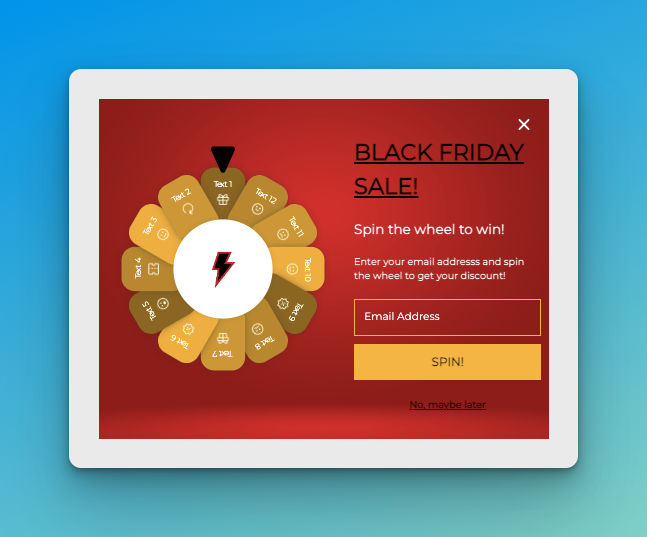
- a gamified spin if you can live with a high share of 10% slices and you will still send a welcome series
Pre-ticked "subscribe me" boxes are not consent under GDPR Article 7. UK PECR still wants a positive action for electronic mail marketing. Put a one-line notice under the button, a link to the privacy page, and a way to unsubscribe in the first mail. A cookie banner does not cover this.
Which tool fits which email-capture job?
Pick the job, then the product.
- OptinMonster is best for teams that will run split tests and read the report.
- Privy is best for Shopify stores that want the popup and the follow-up email in one product.
- Sleeknote is best for ecommerce teams who care how the form looks across several domains.
- Popupsmart is a fair "live this afternoon" builder if you already have an ESP.
On Shopify, StoreCensus's email-app ranking (updated 23 August 2026) puts Klaviyo first at 274,598 installs. Privy sits at 37,069. If you already pay for Klaviyo, start with its forms. Do not add a second popup app on top unless you have a targeting need Klaviyo cannot cover.
On WordPress, OptinMonster's plugin lists 1+ million active installs. That is the conversion-suite pick. Popup Maker is the free, self-hosted pick at 780,000+ installs. Details in best popup builder for WordPress.
Common questions
Is 2% a good conversion rate for an email popup?
It is the middle of the published band, not a target. Omnisend measured 2.1% across 1.24 billion displays and Sleeknote 4.23% across 516 million, on different traffic and different offers. Judge your own number against your own previous number, and against what the addresses do in the welcome flow. A 6% rate that opens nothing is worse than a 2% rate that buys.
Should the discount code appear on screen or in the email?
Both, but the email is the one that matters. A code shown only on the thank-you screen is gone the moment the tab closes, and it gives the address no reason to be confirmed. Show it on screen for the shopper who will use it now, and send it so the address has to work before the discount does.
Does a cookie banner cover newsletter consent?
No. A cookie dialog is about storing or reading information on the device. A newsletter signup is about processing an email address to send marketing. Accepting the first does not create consent for the second, and a pre-ticked subscribe box does not satisfy GDPR Article 7 either. Two objects, two notices.
How long should you wait before showing the form again to someone who closed it?
Seven days at minimum, and never twice in one session. A close is an answer. Re-asking within the same visit reads as a malfunction, and on mobile search traffic a second overlay is the pattern that produces the back-click Google's page experience signals are built to notice.
Which builder fits email popups
The tools this page argues for, best fit first, with the entry price and billing basis taken from each vendor’s own pricing page.
| Tool | Best for this job | Free tier | Starts at | Metered on |
|---|---|---|---|---|
| OptinMonster | Split tests you will actually read the report for | None | $9Basic, per month, billed annually | Campaign impressions |
| Privy | Shopify capture plus the send, one bill | Free trial only | $24Pop-ups & Displays, per month | Monthly pageviews |
| Sleeknote | Forms that match the store across several domains | Free trial only | $69Core (0–25,000 monthly visitors), per month | Monthly visitors |
| Popupsmart | Live this afternoon, feeding an ESP you already pay for | Free plan | $32.50Basic, per month, billed annually | Monthly pageviews |
Prices researched August 2026. Several tools charge a different rate after the first term; each tool’s own pricing breakdown carries the renewal figure. Where these numbers come from is set out below.
How this page was researched
- Prices come from the vendor, on a date
- The 4 figures in the table above were read from each vendor’s own pricing page in August 2026, not from a feature feed or a comparison chart. Each tool’s pricing breakdown links the page the number came from and states the date it was checked, so a figure that has since moved is visible as stale rather than presented as current.
- Review sentiment is quoted, not scored
- G2’s own summary was collected for OptinMonster and Popupsmart in August 2026. Privy and Sleeknote have no such summary on G2, so they appear here without one rather than with a rating we made up. No page on this site prints a star score, because a single number hides the trade-off the comparison exists to explain.
- Every figure names its source
- Conversion and abandonment numbers on this page are vendor and institute datasets with the publisher, the sample size and the publication date attached, so you can weigh who measured them. Where two datasets disagree, both are shown rather than averaged into one comfortable figure.
- Who wrote it
- Emel Dalabasmaz, SEO Executive at Flatart, working in popup builders, conversion rate optimization and on-site messaging. Full profile and credentials, and what this site is and is not.
Other popup types
About the author

SEO Executive at Flatart
Emel Dalabasmaz graduated in Advertising and Public Relations from Anadolu University. She began in social media and carried that grounding — content, brand communication and performance — into SEO. For more than ten years she has worked on growth for brands across a range of industries, pairing a communications perspective with data and technical analysis to build a digital presence that holds up over time. At Flatart, she has worked for more than ten years with over 250 brands and set up popups for more than 70% of them. She has tried the popup tools covered by PopupBuilder.io for agency customers and read G2 customer reviews as part of her product research.
- Education
- Advertising and Public Relations, Anadolu University
- Writes about
- Popup builders, Conversion rate optimization, On-site messaging, SaaS pricing research, SEO, Technical SEO, Content strategy, Digital marketing