

Feedback and survey popups that people finish
 Emel Dalabasmaz
A feedback popup is a question after a task, not a newsletter form with a smiley face. Ask one thing, on the page where the task ended. Keep it off first load and off checkout. If the answer can identify a person, treat it as personal data. NPS, CSAT and "why did you leave" are different campaigns.
When is a survey popup better than a link in an email?
On-site, you catch the session that just happened. Email catches the person who already bought, a day later. Use both, not one overlay that tries to be a research panel.
Good on-site moments:
- after a purchase confirmation, for CSAT or a 0 to 10 NPS
- on a knowledge-base article, after 50% scroll, "did this answer it?"
- on cart abandon, a single reason list (shipping, size, payment) rather than a paragraph box
- on mobile, a bottom sheet with two taps, not a ten-field form
Bad moments: first paint, mid-checkout, on top of a cookie banner, or every page of a session. Google's intrusive interstitial note still applies if a promotional or research overlay blocks the content someone opened from search.
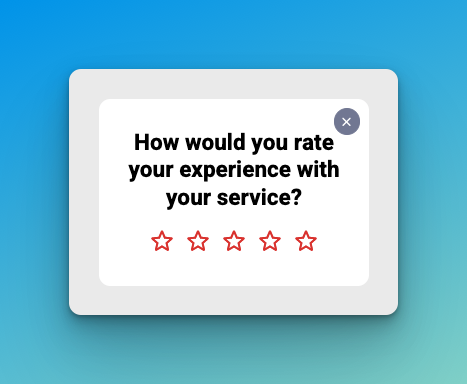
Sleeknote is best for ecommerce teams who want a post-purchase question that looks like the rest of the store. Wisepops is best if you will target by URL, language and returning-visitor rules so the same person is not surveyed twice. OptiMonk fits stores that already run on-site campaigns and want NPS or a yes/no branch without a separate survey product.
How many questions can you ask before people bounce?
Omnisend's 2025 popup dataset (1.24 billion displays) is about email forms, but the field-count pattern travels: conversion held near 2.1% through three fields and fell to 1.5% at four. A survey with four open boxes will do worse.
Keep the first step to one interaction:
- 0 to 10, or 1 to 5 stars
- yes / no ("did you find what you needed?")
- a short list of reasons for leaving a cart
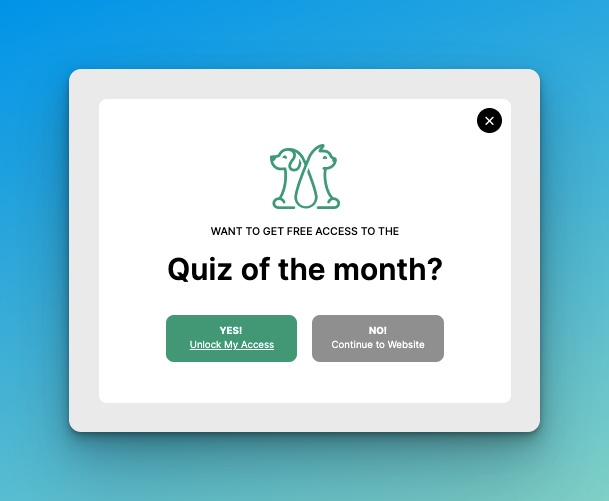
If they pick a low score, then offer an optional comment. Do not require an email to complain. You will bias the sample toward people who want a discount.
Baymard's cart-abandonment compilation (70.22% average, updated 22 September 2025) is a reminder that "why did you leave?" on cart is a recovery tool only if the answers change the site. If 40% of leavers cite extra costs, the follow-up is a shipping-total on the product page, not another popup.
Do you need consent for a feedback form?
Sometimes. A nameless 1 to 5 score with no identifier is usually low risk. A comment box, an email field, or a score tied to a logged-in account is personal data under GDPR. Then you need a purpose, a notice, and a retention limit.
Do not hide a marketing opt-in under a feedback submit. That fails GDPR Article 7 (consent must be specific and withdrawable) and, for email, UK PECR. Two checkboxes if you truly need both: one for contacting them about this reply, one for the newsletter.
Cookie consent is still a separate dialog. A survey tool that sets analytics cookies before the CMP has an answer is a PECR problem, not a UX nit.
What should you do with the answers?
Write the routing down before you launch.
| Campaign | Where it fires | First interaction | How often | What happens to the answer |
|---|---|---|---|---|
| CSAT | Order confirmation | 1 to 5 stars | Once per order | Low scores go to support, not to a win-back send |
| NPS | Confirmation or account page | 0 to 10 | Once per 90 days per person | 0 to 6 tags the contact and opens a conversation |
| Help-centre check | Knowledge-base article, 50% scroll | Yes or no | Once per article per session | "No" opens a ticket or links the next article |
| Cart-exit reason | Cart, on leave | A short list of reasons | Once per session | "Shipping" becomes product-page copy, not another popup |
| Ops report | The page that was wrong | One free-text line | Uncapped | An ops ticket. It is not a marketing metric |
If a row has no last column, do not run it. A survey you will not act on still costs the visitor the interruption.
- NPS 0 to 6: tag the contact, send to support, do not add them to a win-back blast the same day
- cart reason "shipping": show the threshold on the next visit, or fix the product-page copy
- help-centre "no": open a ticket, or link the next article
- store-locator "wrong hours": that is an ops ticket, not a marketing metric
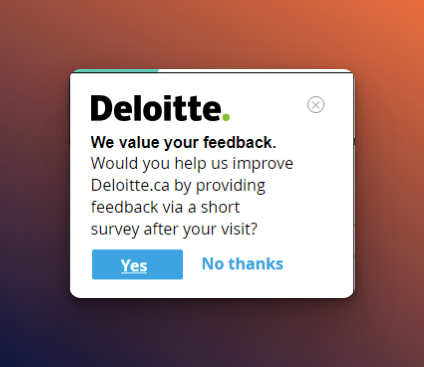
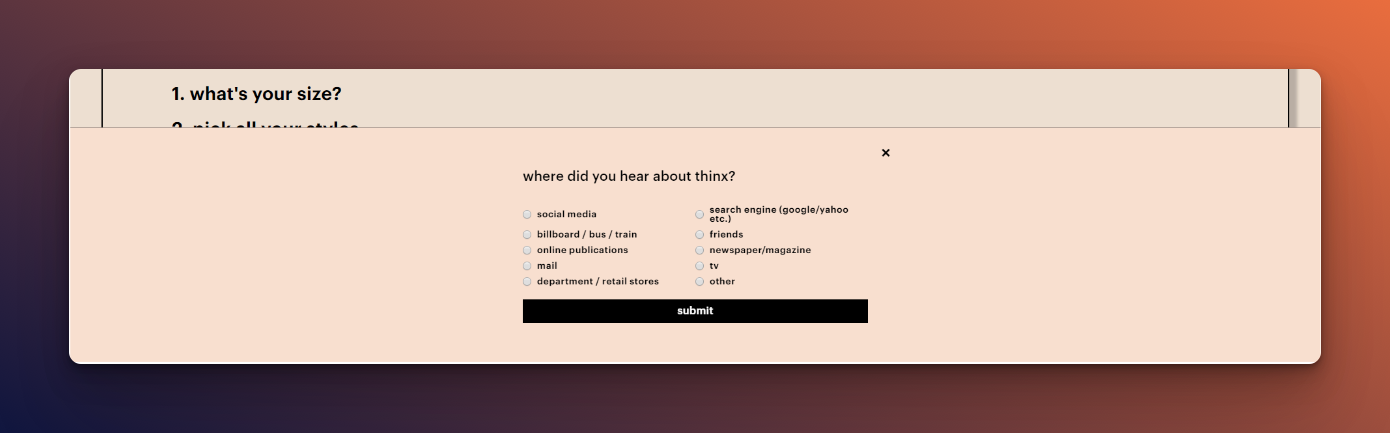
Frequency: once per 90 days per person for NPS, once per session for cart-reason, never on the thank-you page if an email survey is already scheduled for that order.
If you only needed a contact form, use a form popup. If you only needed a sale, use a promotion popup. A smiley scale that dumps into the newsletter list is how survey data goes bad.
Common questions
Should you incentivise a survey response?
Rarely, and never for NPS. A discount attached to a rating buys you the opinions of people who want the discount, which is the one group whose score tells you least. Prize draws have their own promotional rules on top. If response volume is the problem, move the question earlier and cut it to one tap.
How long should a survey popup stay on screen?
Until it is answered or closed, with no timer. A survey that vanishes mid-thought produces a partial response you cannot interpret, and an auto-close on mobile usually fires while the keyboard is still open. What should be capped is how often it returns, not how long it waits.
Should the survey ask for an email?
Only as an optional second step, and only when you intend to reply. Requiring an address to file a complaint biases the sample toward people who want compensation and turns an anonymous rating into personal data with a retention obligation attached. Ask after the score, never before it.
Is NPS worth running on a small store?
The number is not, at low volume. A handful of responses a month produces a score that swings on one detractor and tells you nothing you could act on. The free-text answer behind the score is still worth collecting, so run the question and read the comments rather than reporting the index.
Which builder fits feedback survey popups
The tools this page argues for, best fit first, with the entry price and billing basis taken from each vendor’s own pricing page.
| Tool | Best for this job | Free tier | Starts at | Metered on |
|---|---|---|---|---|
| Sleeknote | A post-purchase question that looks like the rest of the store | Free trial only | $69Core (0–25,000 monthly visitors), per month | Monthly visitors |
| Wisepops | Rules that stop the same person being surveyed twice | Free trial only | Not publishedNo figure on the vendor's page | Monthly pageviews |
| OptiMonk | NPS or a yes/no branch inside campaigns you already run | Free plan | $29Essential, per month | Monthly pageviews |
Prices researched September 2026. Several tools charge a different rate after the first term; each tool’s own pricing breakdown carries the renewal figure. Where these numbers come from is set out below.
How this page was researched
- Prices come from the vendor, on a date
- The 3 figures in the table above were read from each vendor’s own pricing page in September 2026, not from a feature feed or a comparison chart. Each tool’s pricing breakdown links the page the number came from and states the date it was checked, so a figure that has since moved is visible as stale rather than presented as current.
- Review sentiment is quoted, not scored
- G2’s own summary was collected for OptiMonk in August 2026. Sleeknote and Wisepops have no such summary on G2, so they appear here without one rather than with a rating we made up. No page on this site prints a star score, because a single number hides the trade-off the comparison exists to explain.
- Every figure names its source
- Conversion and abandonment numbers on this page are vendor and institute datasets with the publisher, the sample size and the publication date attached, so you can weigh who measured them. Where two datasets disagree, both are shown rather than averaged into one comfortable figure.
- Who wrote it
- Emel Dalabasmaz, SEO Executive at Flatart, working in popup builders, conversion rate optimization and on-site messaging. Full profile and credentials, and what this site is and is not.
Other popup types
About the author

SEO Executive at Flatart
Emel Dalabasmaz graduated in Advertising and Public Relations from Anadolu University. She began in social media and carried that grounding — content, brand communication and performance — into SEO. For more than ten years she has worked on growth for brands across a range of industries, pairing a communications perspective with data and technical analysis to build a digital presence that holds up over time. At Flatart, she has worked for more than ten years with over 250 brands and set up popups for more than 70% of them. She has tried the popup tools covered by PopupBuilder.io for agency customers and read G2 customer reviews as part of her product research.
- Education
- Advertising and Public Relations, Anadolu University
- Writes about
- Popup builders, Conversion rate optimization, On-site messaging, SaaS pricing research, SEO, Technical SEO, Content strategy, Digital marketing