

Promotion popups: sales windows, not permanent 10% off
 Emel Dalabasmaz
A promotion popup is a timed offer on a matching page: a sale window, a threshold to free shipping, a new drop. Schedule a start and an end. Baymard's 70.22% average cart abandonment is mostly extra costs and checkout friction, not a missing firework overlay. Keep first-load full-screen takeovers off mobile search traffic.
What counts as a promotion popup?
Copy that changes what the shopper pays or gets, with a window:
- a seasonal sale with a real end datetime
- free shipping over a number you already honour at checkout
- a new drop or restock, linked to the collection
- a gift-with-purchase rule
- an upsell on cart ("add the pouch, £12, and you clear free shipping")
Not: a permanent "10% for new visitors" that never expires. That is a list-growth bribe. Put it on the email popup and hide it from people who already subscribed.
| Promotion | Shape | Pages | Window | What ends it |
|---|---|---|---|---|
| Seasonal sale | Bar sitewide, overlay on product and cart | Storefront, never checkout | The published dates | The hour the checkout discount dies |
| Free-shipping threshold | Bar, plus a progress indicator on cart | Product, collection, cart | While the threshold holds | A change to the threshold |
| New drop or restock | Slide-in linked to the collection | Collection and related products | Until stock is normal | Stock level |
| Gift with purchase | Cart overlay | Cart only | The campaign dates | The gift running out |
| Cart upsell | Inline module, or a small overlay | Cart | Ongoing | Margin, when it stops working |
| Permanent new-visitor discount | Not a promotion | Belongs on the email popup | None, which is the problem | Nothing, which is also the problem |
Every row but the last has an end condition written before launch. That column is the difference between a campaign and the Boxing Day bar still running in March.
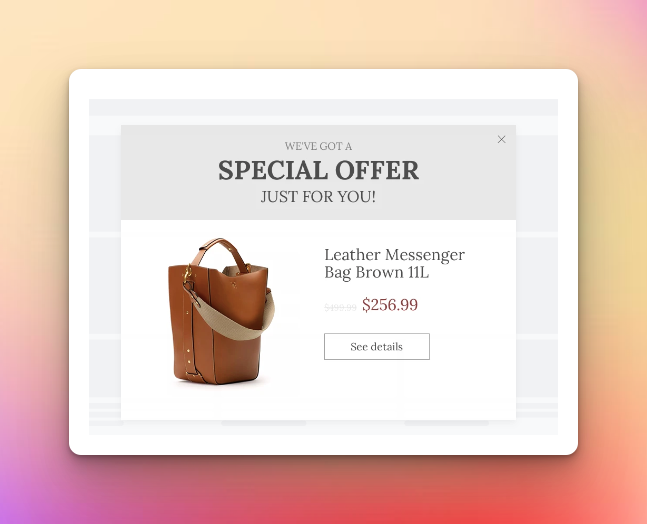
Sleeknote is best for ecommerce teams running promotions across several domains who care how the overlay looks. OptiMonk is best when the promotion is a product block or a shipping bar you will personalise. Hello Bar is best when the whole campaign is one sentence at the top of the page.
When should it appear, and when should it die?
Schedule it. Manual "we will remember to pause it" is how January still shows Boxing Day.
A working pattern:
- Bar on all storefront pages during the window, delayed 3 to 5 seconds so LCP can hold. Core Web Vitals still want LCP at 2.5s or under and CLS at 0.1 or under. A bar that pushes the hero down after load is CLS.
- A larger overlay only on product and cart, after scroll or on exit-intent for desktop.
- Nothing on checkout.
- Campaign off at the same timestamp the checkout discount dies.
Google's intrusive interstitial document (updated 10 December 2025) still says not to cover the whole page with a promotional dialog. A Black Friday takeover on mobile search landing pages is the example of what not to do. Use a bar there.
Baymard: 70.22% average abandonment, and 40% of the non-browsing reasons are extra costs. If your promotion is free shipping, print the threshold on the product page and on the bar. Do not hide it behind a spin.
How do you promote without training people to wait for a code?
- Put the price they will pay on the product page. The popup confirms it, it does not invent it.
- One code per window. Stacking SITE10 plus EXIT15 plus wheel20 is how AOV dies.
- Returning customers: hide the new-visitor discount. Show a loyalty or shipping reminder instead.
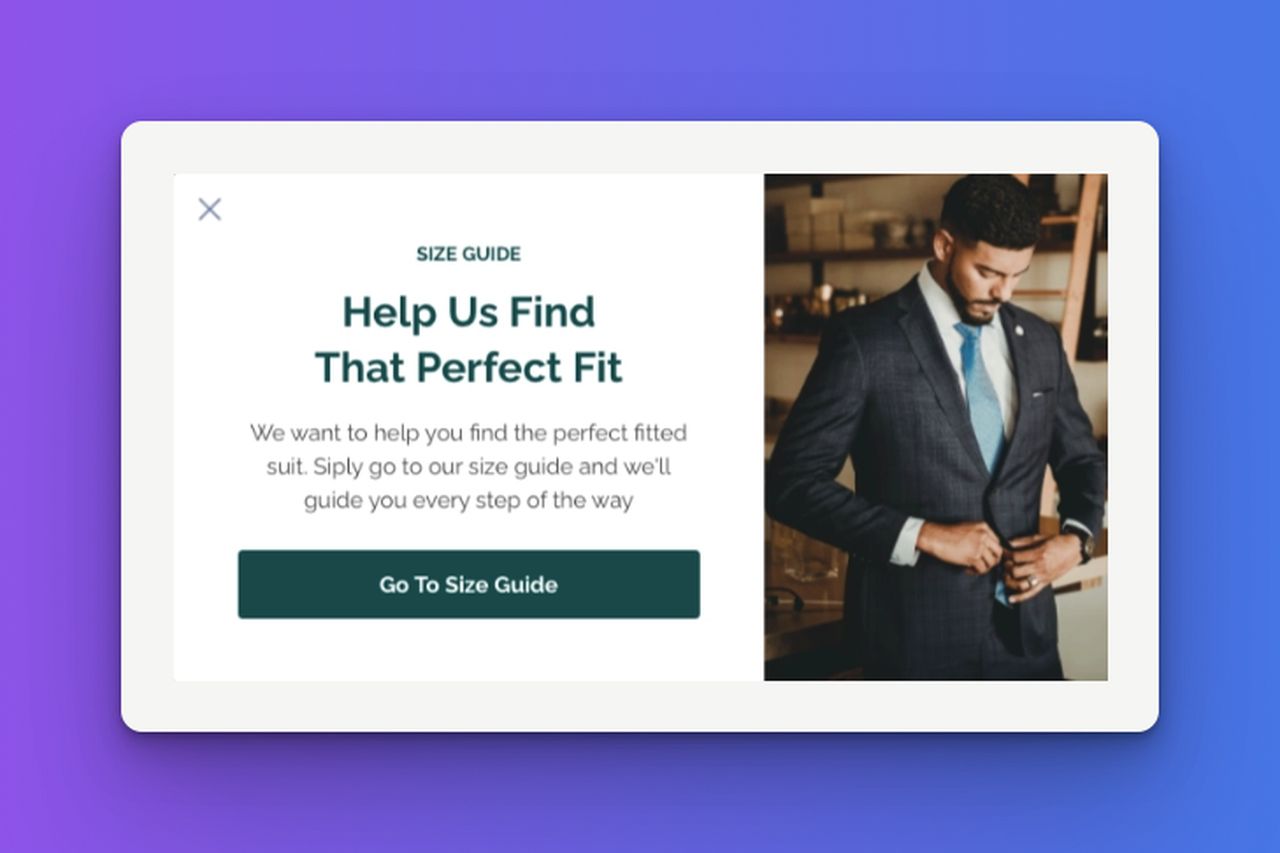
- Size guides, returns and delivery dates convert without a code. Sleeknote treats those as promotion-adjacent overlays for a reason.
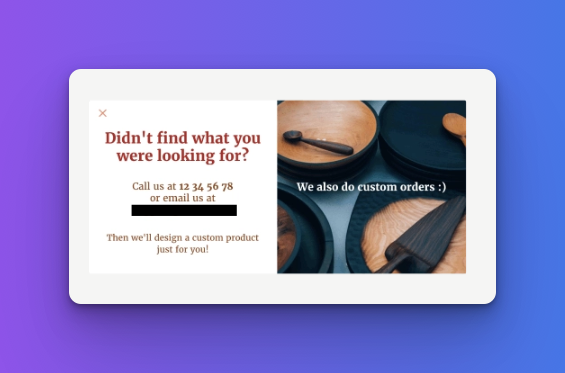
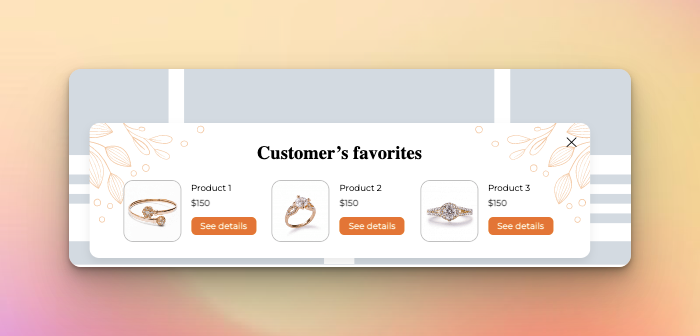
Privy is the Shopify pick when the overlay should also email or text the code. Adoric is the pick if recommendations on cart are the actual promotion. Popupsmart is enough for a scheduled bar and a simple overlay if you already have the discount in the cart platform.
What should you measure besides clicks?
- discount rate and AOV in the same week
- share of orders that used the code without seeing the overlay (leakage)
- mobile vs desktop conversion, because a wheel that works on a mouse may fail on a thumb
- CLS and INP on the templates that carry the bar
If the overlay's only job is "look busy in Q4," skip it. A scheduled theme banner with no extra script is kinder to INP (good at 200ms or under since it replaced FID in March 2024).
For the cart-specific version of this, use cart abandonment popups. For the "we are closed on Monday" version, use announcement popups.
Common questions
How many discount codes should be live at once?
One per window. Stacking a sitewide code, an exit code and a wheel prize means the shopper hunts for the best of the three and you pay the largest, on an order that was already coming. It also makes the campaign report unreadable, because every order matches several attributions.
Should returning customers see the new-visitor discount?
No. Suppress it for anyone with an order or a subscription, and show a shipping reminder or a loyalty message instead. A regular who discovers that a private window is cheaper than their account has learned something expensive about how you price.
Does a promotion bar hurt Core Web Vitals?
It does when it injects into the document flow after load, because the hero moves and that is measured as layout shift against a 0.1 budget. Overlay the bar or reserve its height in CSS before it appears. The second cost is the script itself competing for the main thread on a page whose INP is already near 200ms.
What share of code redemptions should come from the popup?
Measure it before you decide. Track orders that used the code without ever seeing the overlay — leakage to voucher sites, forums and browser extensions. If most redemptions never met the campaign, the popup is not what is spending your margin, and the fix is a code that is harder to scrape rather than a different widget.
Which builder fits promotion popups
The tools this page argues for, best fit first, with the entry price and billing basis taken from each vendor’s own pricing page.
| Tool | Best for this job | Free tier | Starts at | Metered on |
|---|---|---|---|---|
| Sleeknote | Promotions across several domains that look like the store | Free trial only | $69Core (0–25,000 monthly visitors), per month | Monthly visitors |
| OptiMonk | A product block or shipping bar you will personalise | Free plan | $29Essential, per month | Monthly pageviews |
| Hello Bar | A campaign that is one sentence at the top of the page | Free plan | $39Growth, per month, billed annually | Displayed popup views |
| Privy | An overlay that also emails or texts the code | Free trial only | $24Pop-ups & Displays, per month | Monthly pageviews |
| Adoric | Cart recommendations as the actual promotion | Free plan | $100Basic, per month | Monthly pageviews |
| Popupsmart | A scheduled bar when the discount lives in the cart platform | Free plan | $32.50Basic, per month, billed annually | Monthly pageviews |
Prices researched August 2026. Several tools charge a different rate after the first term; each tool’s own pricing breakdown carries the renewal figure. Where these numbers come from is set out below.
How this page was researched
- Prices come from the vendor, on a date
- The 6 figures in the table above were read from each vendor’s own pricing page in August 2026, not from a feature feed or a comparison chart. Each tool’s pricing breakdown links the page the number came from and states the date it was checked, so a figure that has since moved is visible as stale rather than presented as current.
- Review sentiment is quoted, not scored
- G2’s own summary was collected for OptiMonk and Popupsmart in August 2026. Sleeknote, Hello Bar, Privy and Adoric have no such summary on G2, so they appear here without one rather than with a rating we made up. No page on this site prints a star score, because a single number hides the trade-off the comparison exists to explain.
- Every figure names its source
- Conversion and abandonment numbers on this page are vendor and institute datasets with the publisher, the sample size and the publication date attached, so you can weigh who measured them. Where two datasets disagree, both are shown rather than averaged into one comfortable figure.
- Who wrote it
- Emel Dalabasmaz, SEO Executive at Flatart, working in popup builders, conversion rate optimization and on-site messaging. Full profile and credentials, and what this site is and is not.
Other popup types
About the author

SEO Executive at Flatart
Emel Dalabasmaz graduated in Advertising and Public Relations from Anadolu University. She began in social media and carried that grounding — content, brand communication and performance — into SEO. For more than ten years she has worked on growth for brands across a range of industries, pairing a communications perspective with data and technical analysis to build a digital presence that holds up over time. At Flatart, she has worked for more than ten years with over 250 brands and set up popups for more than 70% of them. She has tried the popup tools covered by PopupBuilder.io for agency customers and read G2 customer reviews as part of her product research.
- Education
- Advertising and Public Relations, Anadolu University
- Writes about
- Popup builders, Conversion rate optimization, On-site messaging, SaaS pricing research, SEO, Technical SEO, Content strategy, Digital marketing