

Engagement popups: keep people on the page they chose
 Emel Dalabasmaz
An engagement popup is a related article, a quiz or a click-to-open helper, not a discount shouting over the hero. If the overlay appears before the reader starts, it is not engagement. Google's interstitial rule still applies on mobile search. Core Web Vitals now use INP (200ms), and a heavy widget can fail it.
What is an engagement popup, exactly?
A prompt that extends the session the visitor already chose:
- related post after 60 to 75% scroll
- a two-question quiz that routes to a product or article
- a contents or size-guide panel opened from a button
- a "continue reading" box on long pieces
- a poll whose result you will publish
Not: a first-load newsletter wall, a fake chat that is a form, or a wheel. Those have their own pages (email, forms, gamified).
| Pattern | Trigger | Main-thread cost | What it should replace |
|---|---|---|---|
| Related post | 60 to 75% scroll | One small script | A four-card grid over the paragraph being read |
| Two-question quiz | Click, or after scroll | A quiz library, the heaviest thing here | A category page nobody browses |
| Contents or size-guide panel | Click | Almost none. It is markup | An auto-opening modal |
| Continue-reading box | 50% scroll on long pieces | None | Pagination |
| Poll whose result you publish | After the article ends | Small | A comment form nobody uses |
Three of these five are markup rather than JavaScript, which matters on a page already carrying analytics, a CMP and a chat widget.
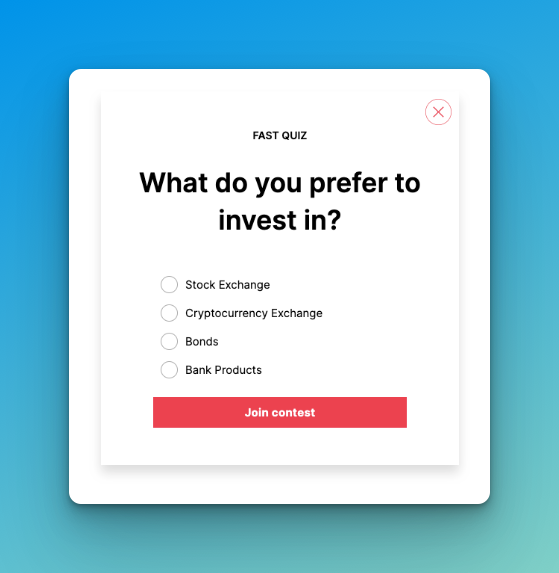
Poptin is best for a small site that wants a quiz or survey overlay without a contract. Wisepops is best if you will target by scroll, returning visitor and language so the related-post box does not fire on the homepage.
When should it fire so it does not read as spam?
After proof of interest. Scroll depth is the clean trigger. Time-on-page is a weak proxy (a forgotten tab looks "engaged").
Keep it off:
- the first viewport of a landing page from ads or search
- checkout and cart (use cart tools there)
- any URL that already has a cookie banner up
Google's intrusive interstitial note (10 December 2025) is about promotional overlays that block content. A related-article slide-in after three screens of reading is closer to navigation. A full-screen "wait, before you read..." is not.
Sleeknote's 2026 numbers put mobile popup conversion at 5.60% versus 2.86% on desktop, across 516 million views. That set is mostly capture and offer forms, but the mobile gap is a reminder: phones will tap a small, late, relevant sheet. They will close a first-load wall.
How do quizzes and related posts avoid becoming lead forms?
Let the first step be the value. Collect email on step two, optional.
A quiz that works:
- "What are you shopping for?" (three choices)
- a product or article, immediately
- "Send this list" as an optional email field
A quiz that does not: email required to see question one.
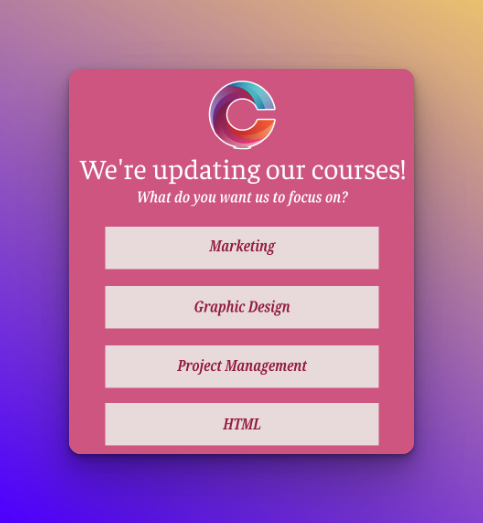
Related posts: one recommendation, with a title the reader can judge, not a four-card grid that covers the paragraph they were on. Click-to-open beats auto-open on mobile.
Omnisend's 2025 field data (1.24 billion displays) showed conversion falling once forms passed three fields. If your "engagement" quiz has six questions plus email plus phone, it is a form popup in costume.
Will this hurt Core Web Vitals?
It can. INP replaced FID in March 2024. Good is 200ms or under. A quiz library, a video embed and a chat widget on the same page will compete for the main thread.
CLS (good at 0.1 or under) spikes when a slide-in pushes layout instead of overlaying it. Overlay, or reserve the space.
Practical limits:
- one engagement campaign per page
- no autoplay video
- load the script after first paint
- if LCP is already near 2.5s, a related-post link in the article footer is the whole feature
OptinMonster is the pick if you will test a slide-in against inline links and want the report. Popupsmart is enough for a click-to-open quiz you need this week. Privy is the wrong centre of gravity unless the "engagement" is really a Shopify welcome offer.
If the metric you care about is revenue, measure that. Time-on-page that comes from a trapped overlay is not engagement.
Common questions
Is time on page a real engagement metric?
Only alongside something the reader chose to do. A forgotten tab looks identical to rapt attention, and an overlay that traps the visitor inflates the number while producing the back-click that actually hurts you. Scroll depth, a second page in the session, or a click on the thing you recommended are all harder to fake.
How many engagement campaigns can one page carry?
One. A quiz, a related-post slide-in and a poll on the same article compete for the same reader and the same main thread, and INP is measured on whichever interaction is slowest. If you cannot choose, the article footer link is the version that costs nothing.
Does a related-post slide-in count as an intrusive interstitial?
Not in the shape described here. Google's guidance is about promotional overlays that obscure the content after a search click. A small panel offering a next article, three screens into the reading, is closer to navigation than to a wall. A full-screen "wait, before you read" on arrival is the thing the guidance names.
Should the quiz ask for an email before showing the result?
No. Gating the answer turns the engagement campaign into a form and destroys the reason the reader started. Show the recommendation immediately, then offer to send it as an optional extra. Omnisend's field-count data is the warning: the moment a quiz has six questions plus email plus phone, it is a form popup in costume.
Which builder fits user engagement increasing popups
The tools this page argues for, best fit first, with the entry price and billing basis taken from each vendor’s own pricing page.
| Tool | Best for this job | Free tier | Starts at | Metered on |
|---|---|---|---|---|
| Wisepops | Scroll, returning-visitor and language targeting | Free trial only | Not publishedNo figure on the vendor's page | Monthly pageviews |
| Poptin | A quiz or survey overlay without a contract | Free plan | $25Basic, per month | Monthly visitors |
| OptinMonster | Testing a slide-in against plain inline links | None | $7Basic, per month, billed annually | Campaign impressions |
| Popupsmart | A click-to-open quiz needed this week | Free plan | $32.50Basic, per month, billed annually | Monthly pageviews |
Prices researched August 2026. Several tools charge a different rate after the first term; each tool’s own pricing breakdown carries the renewal figure. Where these numbers come from is set out below.
How this page was researched
- Prices come from the vendor, on a date
- The 4 figures in the table above were read from each vendor’s own pricing page in August 2026, not from a feature feed or a comparison chart. Each tool’s pricing breakdown links the page the number came from and states the date it was checked, so a figure that has since moved is visible as stale rather than presented as current.
- Review sentiment is quoted, not scored
- G2’s own summary was collected for OptinMonster and Popupsmart in August 2026. Wisepops and Poptin have no such summary on G2, so they appear here without one rather than with a rating we made up. No page on this site prints a star score, because a single number hides the trade-off the comparison exists to explain.
- Every figure names its source
- Conversion and abandonment numbers on this page are vendor and institute datasets with the publisher, the sample size and the publication date attached, so you can weigh who measured them. Where two datasets disagree, both are shown rather than averaged into one comfortable figure.
- Who wrote it
- Emel Dalabasmaz, SEO Executive at Flatart, working in popup builders, conversion rate optimization and on-site messaging. Full profile and credentials, and what this site is and is not.
Other popup types
About the author

SEO Executive at Flatart
Emel Dalabasmaz graduated in Advertising and Public Relations from Anadolu University. She began in social media and carried that grounding — content, brand communication and performance — into SEO. For more than ten years she has worked on growth for brands across a range of industries, pairing a communications perspective with data and technical analysis to build a digital presence that holds up over time. At Flatart, she has worked for more than ten years with over 250 brands and set up popups for more than 70% of them. She has tried the popup tools covered by PopupBuilder.io for agency customers and read G2 customer reviews as part of her product research.
- Education
- Advertising and Public Relations, Anadolu University
- Writes about
- Popup builders, Conversion rate optimization, On-site messaging, SaaS pricing research, SEO, Technical SEO, Content strategy, Digital marketing